February 5, 2026

A Guide to Publishers in the Library Ebook Market

The ebook library lending policies of the Big Six publishers garner most of the attention, because public libraries regard access to best-selling titles as a critical service.

However, it may help to scan the landscape not only for the “Big Six” trade publishers but also for the “fairly large” and the “not so big” and the “further afield” in order to get a fuller sense of publishers’ participation in the overall library marketplace.

The list is meant to be a helpful, not comprehensive, resource. The focus is whether or not publishers are in the library ebook marketplace. It is not meant to be a listing of all possible ways to acquire ebooks for a library collection.
Potential Crisis May Be Brewing in Preservation of E-Journals

A recently released study of e-journal preservation at Columbia and Cornell universities revealed that only about 15 percent of e-journals are being preserved and that the responsibility for preservation is diffuse at best.

One Year Later, HarperCollins Sticking to 26-Loan Cap, and Some Librarians Rethink Opposition

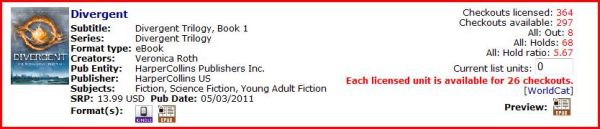
HarperCollins is sticking to its 26-loan cap for library lending of ebooks that it announced one year ago, and the publishing house remains committed to the library market. A number of librarians are rethinking their initial opposition to the policy.

State Librarians Curious as Bilbary Prepares to Launch Its Ebook Platform

Bilbary is preparing for a soft launch of its ebook platform in early March, and four state librarians who constitute the ebook task force of the Chief Officers of State Library Agencies (COSLA) are at least curious about its potential.

ALA, Authors Guild, 3M Weigh In on Penguin-OverDrive Dispute

Penguin Ebook Overdrive Update

Penguin’s decision to terminate its contract with OverDrive has further fractured the library ebook lending market, disturbed the American Library Association, and highlighted the difficulty in finding a single business model that all parties can be comfortable with. And the executive director of The Authors Guild says that public libraries are being put in an “awful situation” by the conflict that has embroiled the large commercial entities of Penguin, Amazon, and OverDrive.

What Patrons Teach Us—and Publishers Should Learn

A new report from LJ indicates that it is vital for libraries to connect with digital patrons, especially ebook readers, and satisfying their expectations has a meaningful upside for both the library users and the publishing community.

Penguin Group Terminating Its Contract with OverDrive

In a stunning development, Penguin Group has extricated itself from its contract with OverDrive, the primary supplier of ebooks to public libraries.

Open Access Advocates Cheer New Bill Seen as Slayer of Research Works Act

U.S. Representative Mike Doyle (D-PA) introduced a bill today that is a direct counterpart to the proposed Research Works Act (RWA), which has stirred deep opposition among researchers, librarians, and advocates of open access.

Simon & Schuster, Macmillan Express Concerns About Library Ebook Lending After ‘Positive’ Talks with ALA

Although the American Library Association and major publishers are talking to each other about ebook lending, it seems they are going to cordially disagree for the foreseeable future — even as more librarians offer evidence that some of the publishers’ concerns may not be completely justified and the CEO for OverDrive says he is “bullish for 2012.”

Random House Reaffirms Commitment to Library Ebook Lending While Raising Prices to Wholesalers

Random House

After an “upbeat and productive” meeting with leaders of the American Library Association on Tuesday, Random House reaffirmed its commitment to library lending of the company’s entire portfolio of ebook titles. At the same time, the company has announced that effective March 1 it is raising ebook prices that it charges library wholesalers such as OverDrive, 3M, and Ingram, which set the ultimate price libraries will pay to lease ebooks.